
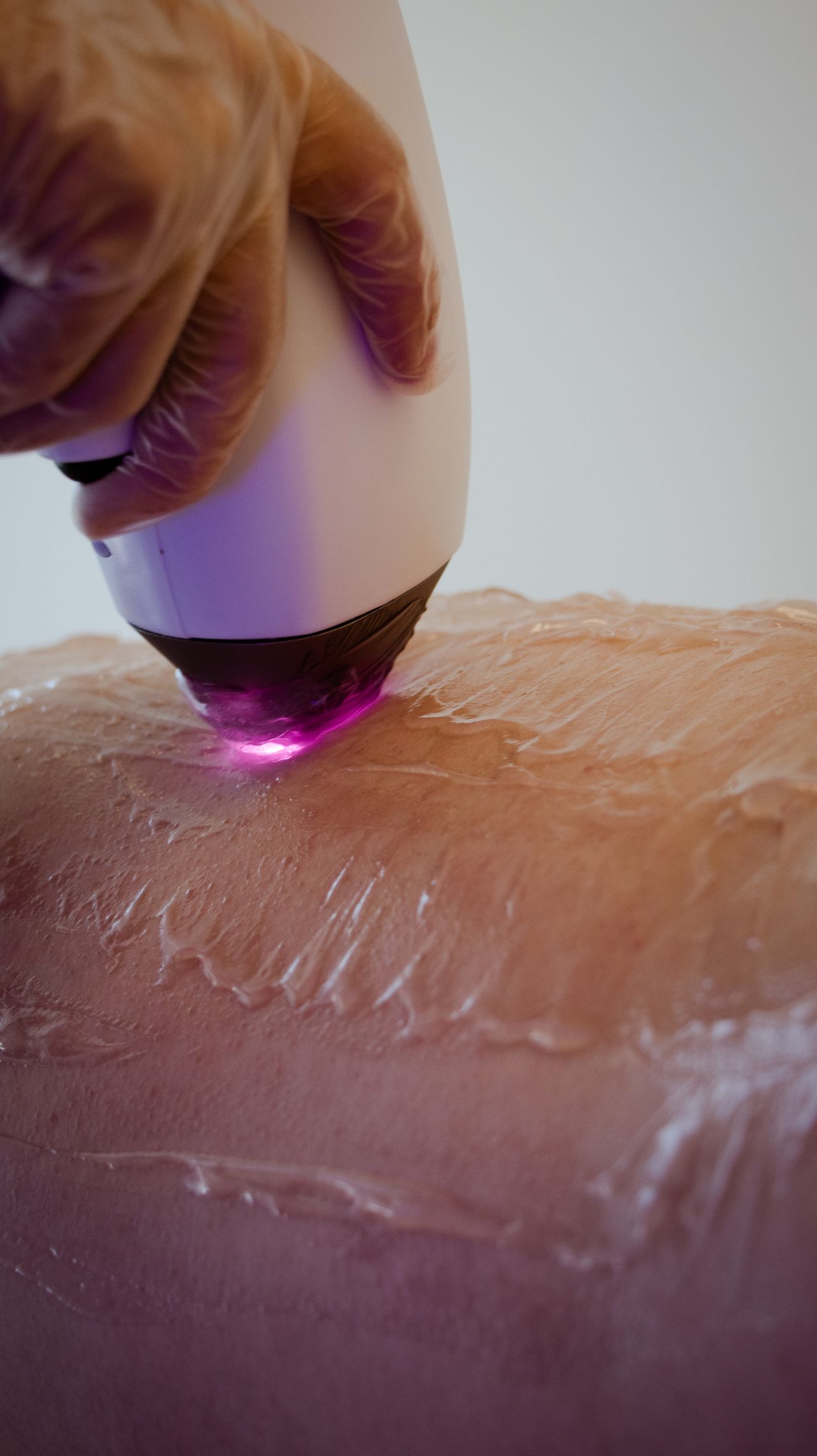
Why Didn't the Laser Live Up to the Promise?
Oct 10, 2026 · @Mary
"Mary, why didn't the laser live up to the promise?"
I get that question so often that I cringe a little when someone sends me a laser video. I already know how the story goes. She saw the glowing after photo, paid for it and healed. Six months later she's standing at the mirror wondering what she paid for.
Most of the time, what went wrong happened in the consult, before the laser ever turned on. Nobody told her what that laser was aiming at. And nobody told her what it could never do, no matter how many times she went back.
So let's start where nobody started with her. Crank an Nd:YAG laser all the way up and it still can't do what a CO2 laser does. Here's why.
Every laser shoots one color
Every laser shoots one color of light, and most of those colors we can't even see. Each color has a number called the wavelength. It's measured in nanometers, and you'll see it written like 1064 or 10,600. That number is the laser's identity. It matters more than whatever name is on the machine.
Your question: "What wavelength is this laser?"
Skin has three things that soak up light: pigment, blood and water. Think of a black t-shirt on a sunny day. It soaks up the light and gets hot. A laser works the same way. It heats whatever soaks up its color.
Each of those three soaks up some colors and ignores others. Put all three on one chart and you get the map every laser lives on.
When you sit down for your consult, I want you to look at her and say, "What is this laser aiming at in my skin? Pigment, blood or water?"
The lasers that aren't aimed at water
At 532, pigment and blood soak up the light. That's the laser for brown spots and red veins. At 1064, the light slips past the surface and heats deeper.
Neither one is aiming at water, and that matters, because resurfacing is a water job. Resurfacing means taking off or rebuilding the top layer of your skin. You need a laser that targets water to do that.
Here's where women get confused. Some 1064 treatments get sold as "laser facials" or even "resurfacing." They can be nice treatments. They are not doing what CO2 does.
I'll say what nobody selling these will say. If you're paying resurfacing prices, you should be getting resurfacing.
Your question: "Is this laser targeting the water in my skin? If it isn't, what result am I actually paying for compared to CO2?"
The lasers that heat water without breaking the skin
Go past 1400 and water takes over. Skin is mostly water, so this light gets stopped near the top.
Some of these lasers, like 1550 and 1927, heat the water underneath without breaking the surface of your skin. You'll hear these called non-ablative, which just means nothing gets removed. You get less downtime and a smaller result, and it usually takes several sessions.
Your question: "Will this laser remove the top layer of my skin, or just heat underneath it?" Then: "How many sessions will I need before I see the result I'm after?"
The two that take the top layer off
Then there are the two lasers that actually take your skin off: Erbium and CO2. These are called ablative.
Erbium gets grabbed so hard by water that it takes off the surface cleanly and leaves very little heat behind. CO2 leaves more heat in the skin around it, and that leftover heat is what tightens. It's also why CO2 usually means a longer recovery.
So if tightening is what you want, CO2 is often the conversation. If you want smoother texture and you can't disappear for two weeks, Erbium might be. Your provider should be able to tell you which one fits and why, in words you understand.
Your question: "Why Erbium or CO2 for me? Which one gets me the tightening I want? And how many days until I can go out in public with each one?"
Fractional
You'll hear the word fractional a lot. It means the laser beam is split into tiny columns with healthy skin left untouched between them, and that untouched skin helps you heal faster.
Same laser. Same wavelength. Fractional changes how much of your skin gets hit. What it's aiming at stays the same. Most CO2 today is fractional, but not all of it, and the difference in recovery is big.
Your question: "Is this fractional or full? About how much of my skin are you treating?"
Settings
Your provider will adjust energy, depth and how densely the laser covers your skin. Those change how hard it hits and how much skin it hits. They don't change what it's aiming at. A 1064 turned all the way up is still a 1064.
Your question: "How deep are you going, and how much of my skin are you covering? Why those settings for me?"
If you have darker skin, read this twice
Even a laser aimed at water can leave dark patches behind, because the heat itself can trigger your pigment to overreact.
You can still have resurfacing. You just need a provider who has a plan for your skin before the laser ever turns on.
Your question: "How many patients with my skin tone have you treated with this exact laser? Can I see their before and after photos? What will you have me do before and after to prevent dark patches?"
So why didn't the laser live up to the promise?
Here's what I see over and over when I dig into a disappointing laser.
It was never a resurfacing laser. She was sold a "laser facial" at 1064 and expected CO2 results. Nobody lied to her, exactly. Nobody explained it either.
It was turned down to sell the downtime. "Back to work tomorrow" is a setting. To get you there, they lower the depth and how much skin gets covered, so you get less recovery and less result. That's a fair trade if you know you're making it. Most women don't.
Your question: "If I want the result in that photo, how much downtime does it really take?"
It needed a series and she got one session. The gentle lasers, the 1550s and 1927s, are built to work over several visits. One session of a series laser is a sample.
Your question: "How many sessions will it take, and what does that cost in total?"
She judged it too early. Collagen is slow. The real result builds over months, and the glow in week two is mostly fresh new skin.
Your question: "When will I see my final result?"
It was asked to fix something lasers can't fix. This is the big one, and the one I care about most. A laser works on the surface of your skin. It can smooth and brighten, and it can tighten a little. It cannot lift a cheek that has fallen or rebuild what's underneath. If the problem is the foundation, no wavelength in the world fixes it from the top.
Your question: "Is what I'm seeing a skin problem or a structure problem? Be honest with me."
Her skin was played safe, and nobody said so. With darker skin, a careful provider will often use gentler settings to protect against dark patches. That's the right call. But she deserved to hear that her plan might take longer, or look different from the photos she saw.
Your question: "Are you adjusting the settings for my skin tone? How does that change my result or my timeline?"
Nobody asked who was holding the laser. A CO2 in the wrong hands does more damage than an Erbium in the right ones.
Your question: "Who will actually be holding the laser, and how many of these have they done on skin like mine?"
And that video that started all of this? It showed you someone else's face on someone else's laser, and it never once told you the wavelength.
Start with what you're trying to heat
So don't walk in asking what setting they'll use. Ask what they're trying to heat. That answer picks the wavelength, and the wavelength picks the laser.
If nobody in the room can explain why this wavelength is right for your skin, in words you understand, you've found the gap.
Wavelength is identity.
The Reality Check: Answering the Critics
Critic Trap 1: "You're not a doctor. You shouldn't be telling people which laser to get."
The Fact: I'm not telling anyone which laser to get. Your provider picks the laser. My job is making sure you can follow the conversation when they do. Every question in this piece is one a good provider should be glad you asked.
Critic Trap 2: "It's the person holding the laser that matters, not the machine."
The Fact: You're right, and it's why that question is on your list. The wavelength is only where you start.
Critic Trap 3: "Settings matter. You're oversimplifying."
The Fact: Settings matter a lot. They decide how deep the laser goes and how much skin it covers. What they can't do is change what the light is absorbed by. That's physics, and the wavelength sets it. Turn a 1064 all the way up and you just get a stronger 1064.
Critic Trap 4: "1064 treatments build collagen too. You're trashing good treatments."
The Fact: I said they can be good treatments. I said they aren't resurfacing the way CO2 or Erbium is. If a woman pays resurfacing prices, she should get a resurfacing result, or know going in that she won't.
Critic Trap 5: "Is some company paying you to name these brands?"
The Fact: No. I am never paid by any company, and I don't have an agenda. You pay me one time for my best advice, and after that the decision is yours. Whether you choose the surgery I'd pick for you, something different, or nothing at all, I don't receive a thing from you or from the provider. Same with lasers, microneedling, all of it.
Last week my client Lisa G. came to me after a doctor recommended Ellacor. I didn't think it was the right choice for her, and I told her so. Then I sent her to my Ellacor blog and the comment Dr. Montague left at the end of it, and I told her the decision was hers. I had nothing to gain either way. She read it and came back with, "I'm listening to you."
I named these brands because they're the names you'll see on a menu, and you deserve to know what each one is aimed at before anyone starts selling. Everyone else in that consult room gets paid when you say yes. I don't. I've been saying it for years: I am the only one in this industry who wants more for you and less from you.
Critic Trap 6: "Your list is missing my laser."
The Fact: Brands come and go. The questions work on any machine ever made. Ask for the wavelength and you'll know where it belongs.
The lasers, sorted by what they're aiming at
When you see a laser name on a menu or a consult sheet, find it here. You'll know what it's built to do before anyone starts selling you.
| Laser | Wavelength | What it does |
|---|---|---|
| Lumenis UltraPulse (ActiveFX, DeepFX, TotalFX) | 10,600 CO2 | Takes the top layer off, most tightening, longest recovery |
| Solta Fraxel Re:pair (the CO2 Fraxel) | 10,600 CO2 | Takes the top layer off |
| Candela CO2RE | 10,600 CO2 | Takes the top layer off |
| Alma Pixel CO2 | 10,600 CO2 | Takes the top layer off |
| DEKA SmartXide | 10,600 CO2 | Takes the top layer off |
| Sciton Contour TRL | 2940 Erbium | Takes the top layer off, less heat left behind, usually faster recovery |
| Sciton ProFractional | 2940 Erbium | Takes the top layer off in tiny columns |
| Fotona Erbium lasers | 2940 Erbium | Takes the top layer off |
| Sciton Halo | 1470 + 2940 | Hybrid: heats underneath and takes the surface off |
| Fotona "4D" | 2940 Erbium + 1064 | Hybrid: more than one wavelength in one machine |
| Solta Fraxel Dual (the Fraxel most people mean) | 1550 + 1927 | Heats water underneath, skin stays intact, needs a series |
| Solta Clear + Brilliant | 1440 or 1927 (Perméa) | Gentle, heats underneath, needs a series |
| Sciton Moxi | 1927 | Gentle, heats underneath, needs a series |
| Lutronic LaseMD | 1927 | Gentle, heats underneath, needs a series |
| Lumenis ResurFX | about 1565 | Heats underneath, skin stays intact |
| Cynosure Icon 1540 | 1540 | Heats underneath, skin stays intact |
| Cutera Laser Genesis | 1064 | Not aimed at water. Often sold as a "laser facial" |
| PicoWay and other pico lasers | 1064 or 532 | Not aimed at water. Built mainly for pigment |
Heads up on the word "Erbium." Fraxel 1550 and Icon 1540 are technically erbium lasers too, but erbium-glass. They are not the 2940 Erbium that takes your skin off. If someone says "Erbium," ask, "2940 or 1550?"
One more thing. Brands add new models and retire old ones, and plenty of machines carry more than one wavelength. The name on the machine still doesn't tell you enough. Ask, "Which wavelength are you using on me today?"
Bring these to your consult
- What wavelength is this laser?
- What is it aiming at in my skin: pigment, blood or water?
- Will it remove the top layer of my skin, or just heat underneath it?
- Why Erbium or CO2 for me, and which one gets me the tightening I want?
- Is this fractional or full, and how much of my skin are you treating?
- If I want the result in that photo, how much downtime does it really take?
- How many sessions will I need, and what does that cost in total?
- When will I see my final result?
- Is what I'm seeing a skin problem or a structure problem?
- Who will actually be holding the laser, and how many have they done on skin like mine?
- How many patients with my skin tone have you treated with this exact laser? Can I see their photos?
- What's your plan to prevent dark patches?
- Why this laser for my skin?
The Regan Method
The Regan Method, The Regan Surgical Collective, and The Regan House are about bringing truth to an industry that doesn't currently want it to exist. But we are changing that, one real conversation at a time. Visit the website and see what patients and doctors are discovering by joining Mary.
Ready to go deeper? Your journey begins the moment you decide you don't want to navigate it alone.
Conversation (0)
Be the first to join the conversation
Reading and posting comments is reserved for members. Sign in or create an account to unlock full community discussions.